
The Cornerstone of Data Integrity: Why Your Professional Lab Balance Still Relies on the RS232 Interface?
Introduction
In a world dominated by USB-C and wireless technology, you might feel a bit puzzled when you see a classic RS232 DB-9 serial port on a new, high-precision instrument from U.S. Solid. This isn't a technological oversight. On the contrary, it is a deliberate choice made in adherence to the most critical elements of data transfer: integrity and reliability. At U.S. Solid, we understand that every measurement is critical. This article will provide a deep dive into why this time-tested interface remains an unwavering cornerstone in the world of rigorous scientific research and quality control.
Part 1: RS232 – A Stable Protocol Engineered for Demanding Environments
Laboratory settings are often filled with potential Electromagnetic Interference (EMI) from equipment like centrifuges, heating mantles, and other analytical instruments. It is in these environments that the core advantages of the RS232 interface truly shine.
- Superior Immunity to Interference: Unlike modern interfaces that use low-voltage signals, RS232 utilizes a higher voltage differential to define its data signals. This design gives it a powerful, inherent resistance to "noise," ensuring that every bit of data transferred from the balance to a computer is accurate, even in complex electromagnetic environments. For measurements precise to 0.1g, or even to the milligram, this stability is a prerequisite for successful experiments.
- Simplicity and Reliability of the Protocol: RS232 is a point-to-point, direct communication protocol that does not require complex drivers or frequent OS updates to maintain compatibility. This "simplicity is reliability" approach means fewer software conflicts, a lower failure rate, and more consistent, long-term operation—critical for labs that require long-duration data monitoring or operate in a validated environment.
Part 2: From Data Collection to Analysis – The Complete U.S. Solid Solution
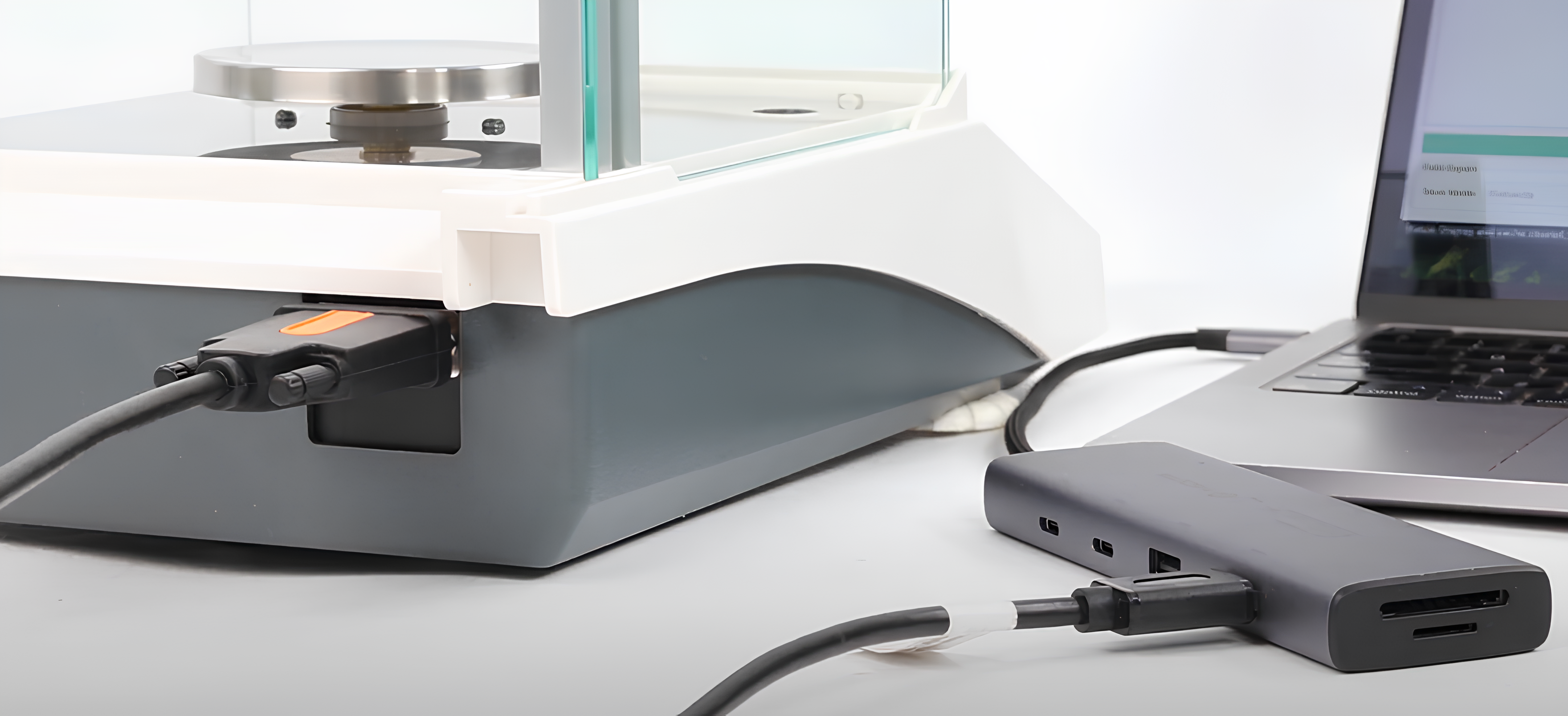
It's one thing to acknowledge the reliability of RS232, but it's another to use it efficiently on modern computers that universally lack serial ports. U.S. Solid not only recognizes this challenge but provides a seamlessly integrated solution to transform raw weighing data into actionable insights.
The Critical Bridge: More Than Just a Connection
With our U.S. Solid RS232 DB9 to USB-A Data Cable, you can easily connect any balance equipped with an RS232 port to your PC or laptop. But that’s just the first step.
The Core Software: U.S. Solid RS232 Data Logger
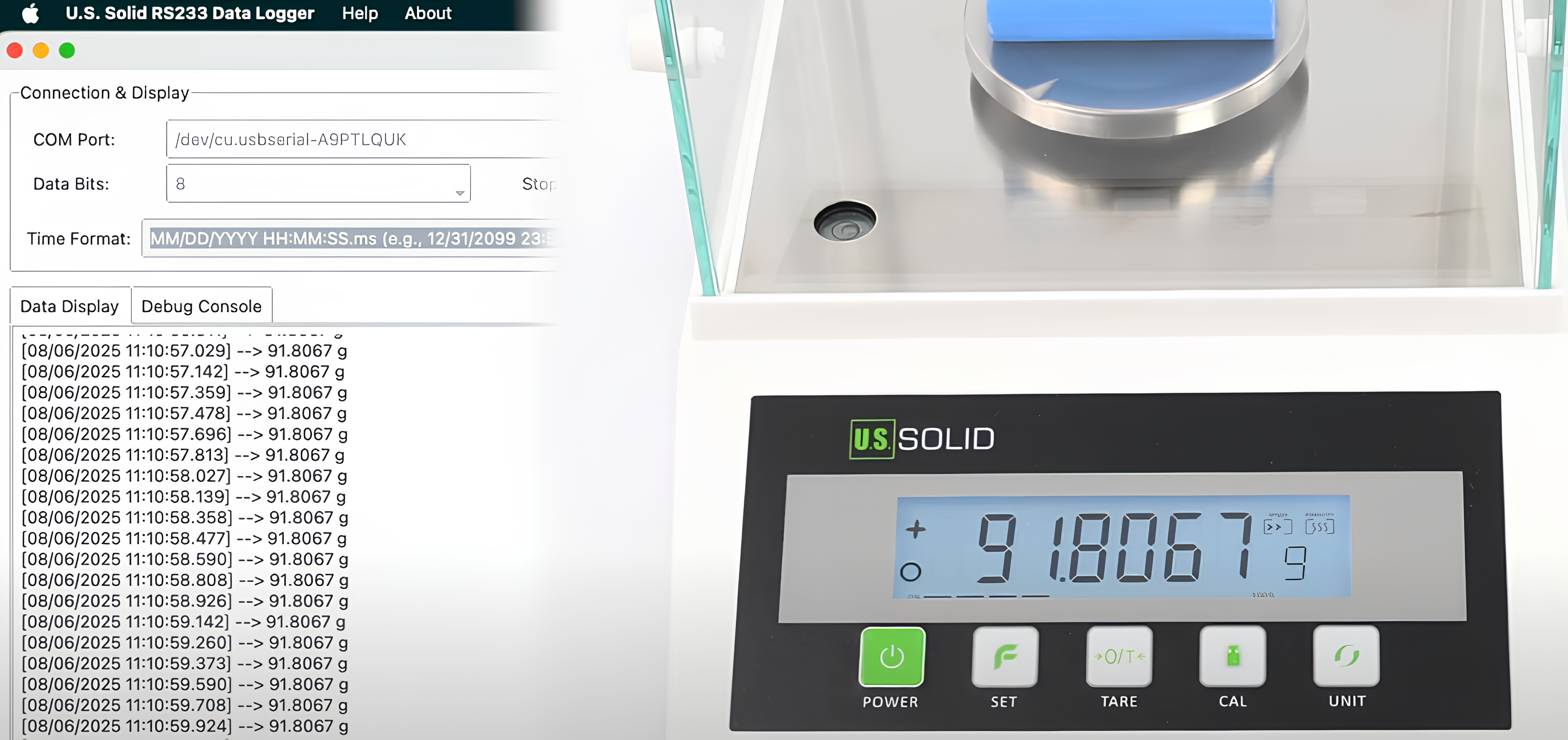
To solve the data logging challenge head-on, we developed our proprietary U.S. Solid RS232 Data Logger software. This powerful tool is designed to work in perfect harmony with our balances, offering you:
- Real-Time Data Display: Instantly and clearly view the balance's live readings on your computer screen, eliminating the need to look back and forth between the instrument and your notes.
- One-Click Data Capture: With a single click or keystroke, capture the current stable weight and log it along with a timestamp, dramatically improving data collection efficiency.
- Effortless Data Export: Easily export all logged data to CSV or other common formats. This allows for direct import into software like Excel, Origin, or a LIMS for further processing and analysis, completely eliminating the tedious and error-prone process of manual transcription.
We don't just provide isolated hardware; we offer a complete workflow from precise measurement to convenient logging and analysis.
Part 3: A Practical Example – The U.S. Solid USS-DBS86-3 Precision Balance
Let's use the U.S. Solid USS-DBS86-3 Precision Balance as an example to see how this complete solution performs in daily work. This balance is an ideal choice for general laboratory applications, with specifications engineered for efficiency and reliability:
- Capacity and Readability: 3100g x 0.1g, meeting a wide range of needs from routine sample preparation to simple formulation.
- Core Sensor: A high-quality strain gauge load cell sensor ensures dependable results.
- Efficient Design: A fast stabilization time of ≤3 seconds, combined with a large 160x160mm stainless steel weighing pan, accommodates larger samples and improves throughput.
- Built-in Functions: Features practical applications like piece counting and tare, and supports both AC and rechargeable battery power to adapt to different workspaces.
Workflow in Action:
Imagine you need to prepare dozens of samples for an experiment. By connecting the USS-DBS86-3 balance to your computer with the RS232 to USB cable and opening our Data Logger software, your process is transformed. Each time you place a sample on the pan and the reading stabilizes, a simple click in the software permanently records the exact weight and time. The entire process is fast, seamless, and completely eliminates the risk of human transcription errors.
Conclusion
The presence of the RS232 interface on a modern precision balance is a mark of professionalism and rigor. It represents an uncompromising stance on data integrity.
At U.S. Solid, we not only uphold this standard but also ensure our customers can leverage the advantages of this classic interface in the most modern and efficient way possible through our dedicated data cables and software. We are committed to providing you with precise, reliable measuring instruments and the powerful data handling tools to match.