




Introduction
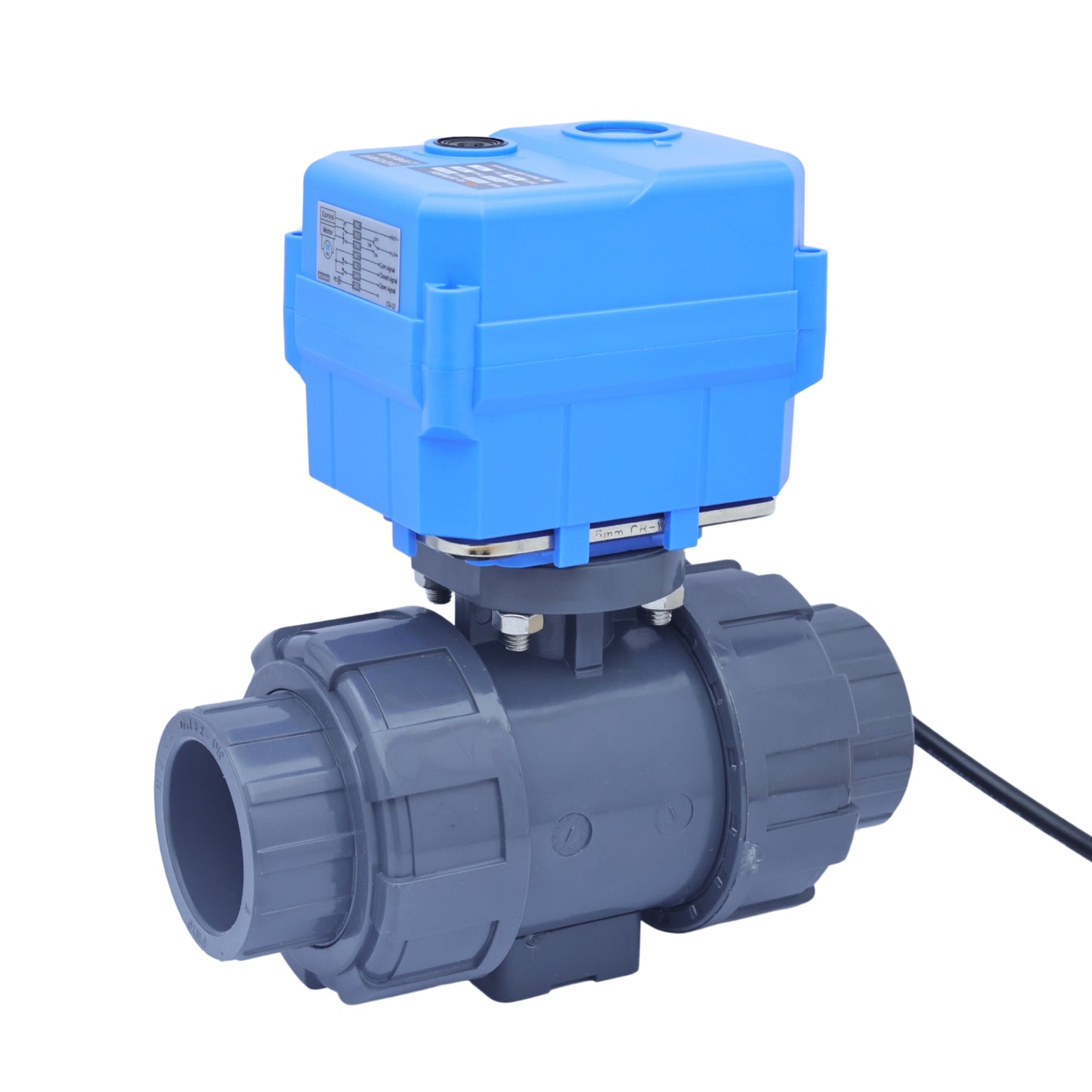
Our electric CPVC ball valve series has been upgraded to include three larger sizes: 1-1/4", 1-1/2", and 2". These larger valves feature a unique US standard socket end & double union connection—enabling exceptional ease of installation and maintenance with a simple solvent cement bond, unlike threaded NPT or G connections. For other connection standards, please contact our customer service.
These valves utilize a 6-wire configuration integrating 3-wire single-control and 3-wire signal feedback functions. Unlike the 2-wire auto-return model, this version does not automatically reset if power is lost; instead, it remains in its current position, providing stable operation for specific flow requirements. The 6-wire setup includes three wires for single-control operation (a common wire, a constant power wire, and a single action control wire)—simply activate the control wire to trigger the valve’s opening or closing action; plus three wires for real-time position signal feedback only, which transmit open/closed status data to your control system for remote monitoring and operational verification. A manual override is also included for use during power outages. All valves have FPM seals for reliable performance.
CPVC vs. UPVC: CPVC offers higher temperature resistance and especially stronger resistance to highly concentrated acid and alkali corrosion. For normal-temperature and general corrosive working conditions, UPVC is a more cost-effective choice.
To learn how to use this product, please refer to the user manual.
Specifications
Model: USS-MSV576
Size: 1-1/4"
Connection: Union & Socket End
Socket Inside Diameter: 42.2mm
Material: CPVC
Working Voltage: DC 24V
Max Power: 15W
Max Torque: 20 N·m
Max. Pressure: 232 psi
Medium Temp: 33.8℉ to 176℉
IP Rating: IP65
Life Expectancy: 20,000Cycles
Close/Open Time: 10-12s
Wiring: 6-wire (3-wire single-control and 3-wire signal feedback)
Manual Function: Yes
Signal feedback function: Yes
Seal: EFPM
Factory set: The valve is set to CLOSED by default. It is a non-spring return model, meaning it does not have a predefined Normally Open (NO) or Normally Closed (NC) state.