
Full Port vs.Standard Port Valves: What’s the Difference and How to Choose
Share
When selecting a valve, many buyers focus mainly on the connection size, such as 1/2", 3/4", or 1". However, two valves with the same connection size may have different internal flow paths. This is where full port and standard port valves become important.
The port design affects flow rate, pressure drop, valve size, cost, and the best application for each valve. Understanding the difference helps you avoid undersizing the valve or paying for more flow capacity than your system needs.
What is a Full Port Valve?
A full port valve has an internal opening that is close to the inside diameter of the pipe. This allows liquid, gas, air, or other media to pass through the valve with minimal restriction.
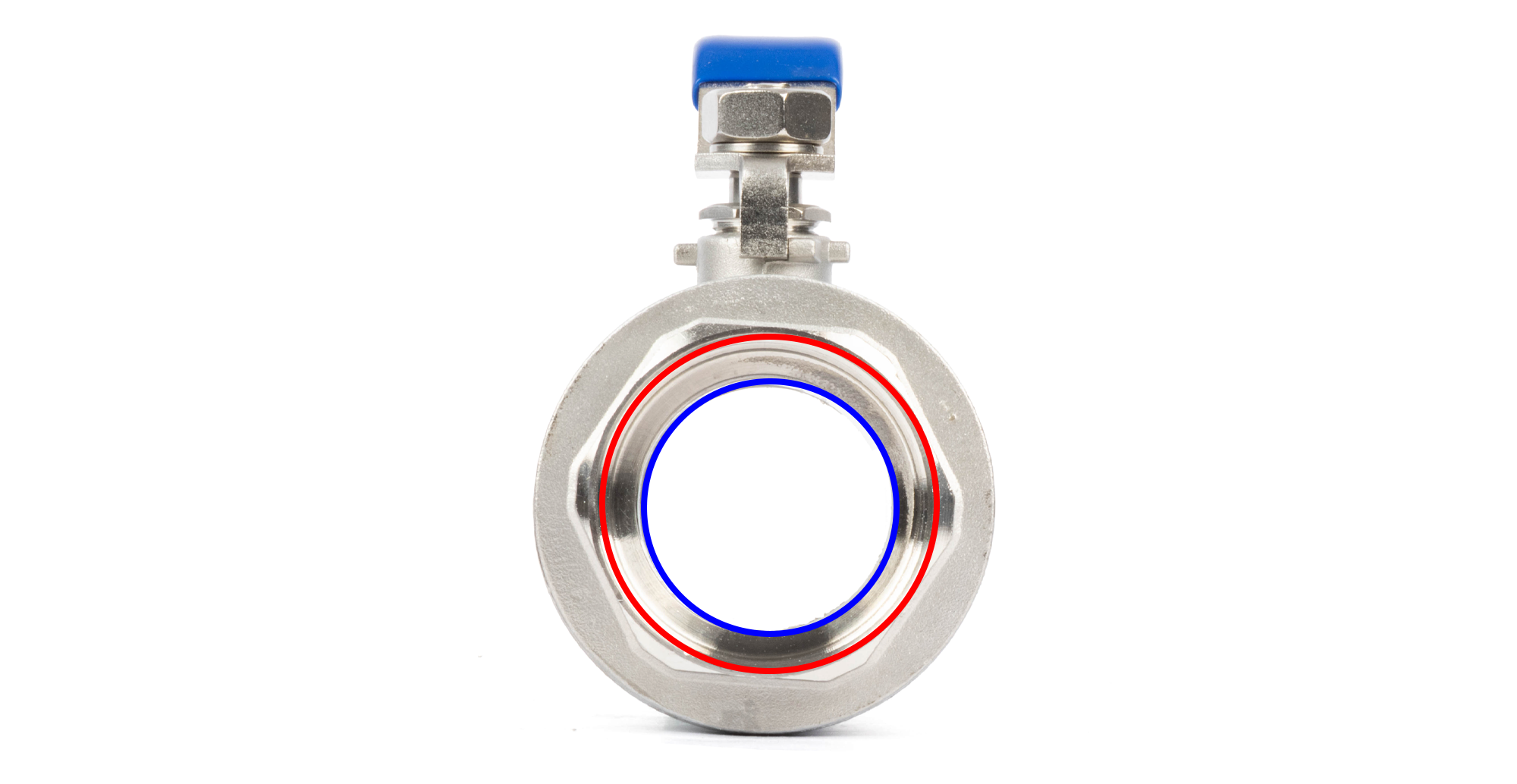
- Higher flow capacity
- Lower pressure drop
- Less flow restriction
- Better performance in high-flow systems
What is a Standard Port Valve?
A standard port valve has an internal opening that is smaller than the pipe size. Although the valve connection may match the pipe size, the flow path inside the valve is reduced.
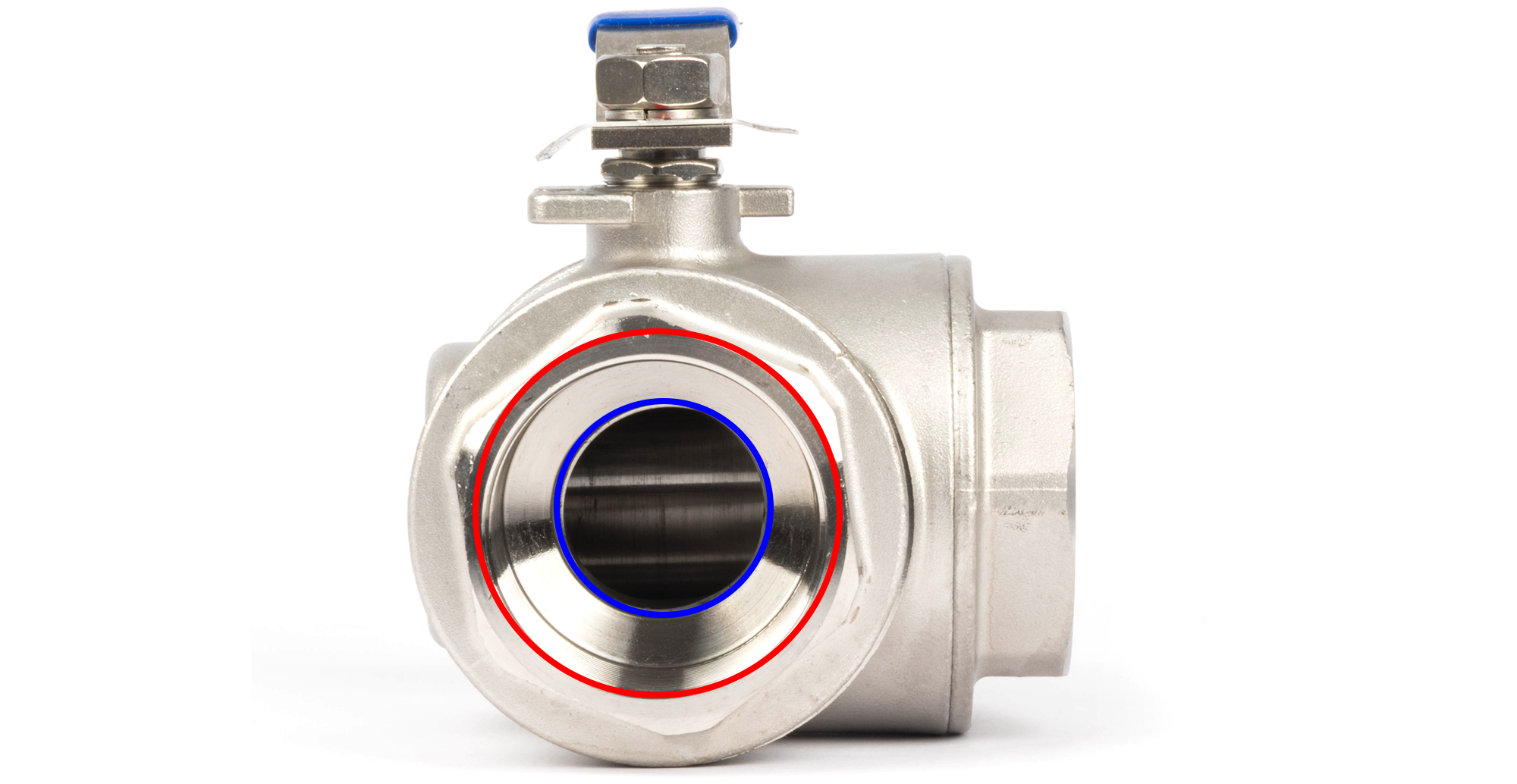
- Moderate flow capacity
- Higher pressure drop compared with full port valves
- More compact valve body
- Lower cost in many applications
Key Differences Between Full Port and Standard Port Valves
| Feature | Full Port Valve | Standard Port Valve |
|---|---|---|
| Internal Opening | Close to pipe inside diameter | Smaller than pipe inside diameter |
| Flow Capacity | Higher | Moderate |
| Pressure Drop | Lower | Higher |
| Valve Size | Usually larger | Usually more compact |
| Cost | Usually higher | Usually lower |
| Best For | High-flow and low-restriction systems | General on/off control and cost-sensitive applications |
How to Identify Full Port and Standard Port Valves
The connection size alone does not tell you whether a ball valve is full port or standard port. A practical way to check is to open the valve fully and measure the smallest diameter of the ball bore, which is the narrowest internal flow path through the ball.
In this guide, full bore corresponds to a Full Port valve, while reduced bore corresponds to a Standard Port valve.
| Nominal Size | Full Port Min. Bore | Standard Port Min. Bore | Standard Port Double-Reduced Min. Bore |
|---|---|---|---|
| DN8 / NPS 1/4 | 5 mm | Not specified | Not specified |
| DN10 / NPS 3/8 | 8 mm | 5 mm | Not specified |
| DN15 / NPS 1/2 | 11 mm | 8 mm | Not specified |
| DN20 / NPS 3/4 | 17 mm | 12 mm | 8 mm |
| DN25 / NPS 1 | 24 mm | 17 mm | 14 mm |
| DN32 / NPS 1 1/4 | 30 mm | 22 mm | 18 mm |
| DN40 / NPS 1 1/2 | 37 mm | 27 mm | 23 mm |
| DN50 / NPS 2 | 49 mm | 37 mm | 30 mm |
| DN65 / NPS 2 1/2 | 62 mm | 49 mm | 37 mm |
| DN80 / NPS 3 | 75 mm | 56 mm | 49 mm |
| DN100 / NPS 4 | 100 mm | 75 mm | 62 mm |
| DN150 / NPS 6 | 151 mm | 100 mm | 75 mm |
| DN200 / NPS 8 | 202 mm | 151 mm | 100 mm |
| DN250 / NPS 10 | 251 mm | 202 mm* | 151 mm |
| DN300 / NPS 12 | 302 mm | 251 mm** | 202 mm |
| DN350 / NPS 14 | 334 mm | 302 mm | 251 mm |
| DN400 / NPS 16 | 385 mm | 334 mm | 302 mm |
| DN450 / NPS 18 | 436 mm | 385 mm | 334 mm |
| DN500 / NPS 20 | 487 mm | 436 mm | 385 mm |
| DN600 / NPS 24 | 586 mm | 487 mm | 436 mm |
For one-piece body design, the minimum flow diameter may be 186 mm. **For one-piece body design, the minimum flow diameter may be 227 mm.
When Should You Choose a Full Port Valve?
A full port valve is often the better choice when maximum flow and minimum pressure loss are important.
- Main pipelines: Helps maintain flow capacity for downstream equipment.
- Pump systems: Reduces resistance and supports better pump efficiency.
- High-flow liquid transfer: Suitable for water treatment, irrigation, cooling systems, and chemical transfer.
- Media with particles or higher viscosity: A larger opening can reduce the risk of blockage.
- Systems requiring lower pressure drop: Helps maintain more stable downstream pressure.
When Should You Choose a Standard Port Valve?
A standard port valve is widely used when maximum flow is not required. It can be a practical and economical choice for many general applications.
- Branch lines: Suitable for auxiliary lines or lower-flow sections of a system.
- General on/off control: Works well when a small pressure drop is acceptable.
- Compact equipment: Often easier to install where space is limited.
- Cost-sensitive projects: Usually more economical than full port valves.
- Clean media applications: Suitable for clean water, air, gas, or low-viscosity liquids.
How to Choose Between Full Port and Standard Port
Choose Full Port If
- You need maximum flow
- The valve is on a main line
- The system includes a pump
- Pressure drop must be minimized
- The medium may contain particles or sediment
Choose Standard Port If
- Moderate flow is acceptable
- The valve is on a branch line
- You need general on/off control
- Installation space is limited
- Cost is an important factor
Conclusion
The main difference between full port and standard port valves is the size of the internal flow path. A full port valve provides higher flow and lower pressure drop, making it suitable for main lines, pump systems, high-flow applications, and media that may clog easily.
A standard port valve is more compact and often more cost-effective, making it suitable for general on/off control, branch lines, small equipment, and applications where maximum flow is not required.
Find the Right Valve for Your Application
Explore U.S. Solid valves for water, air, gas, automation, industrial equipment, and more.
Shop U.S. Solid Valves