





Introduction
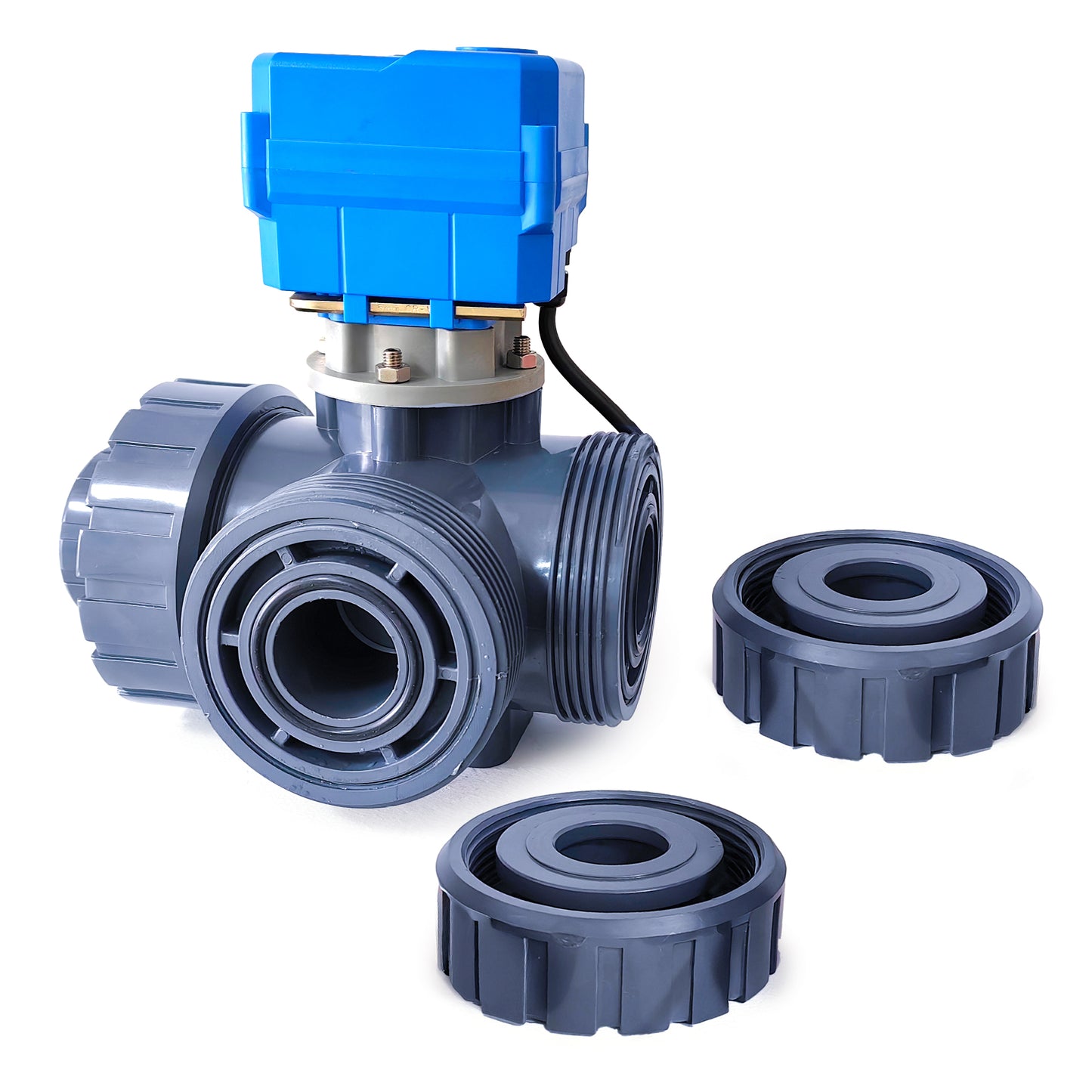
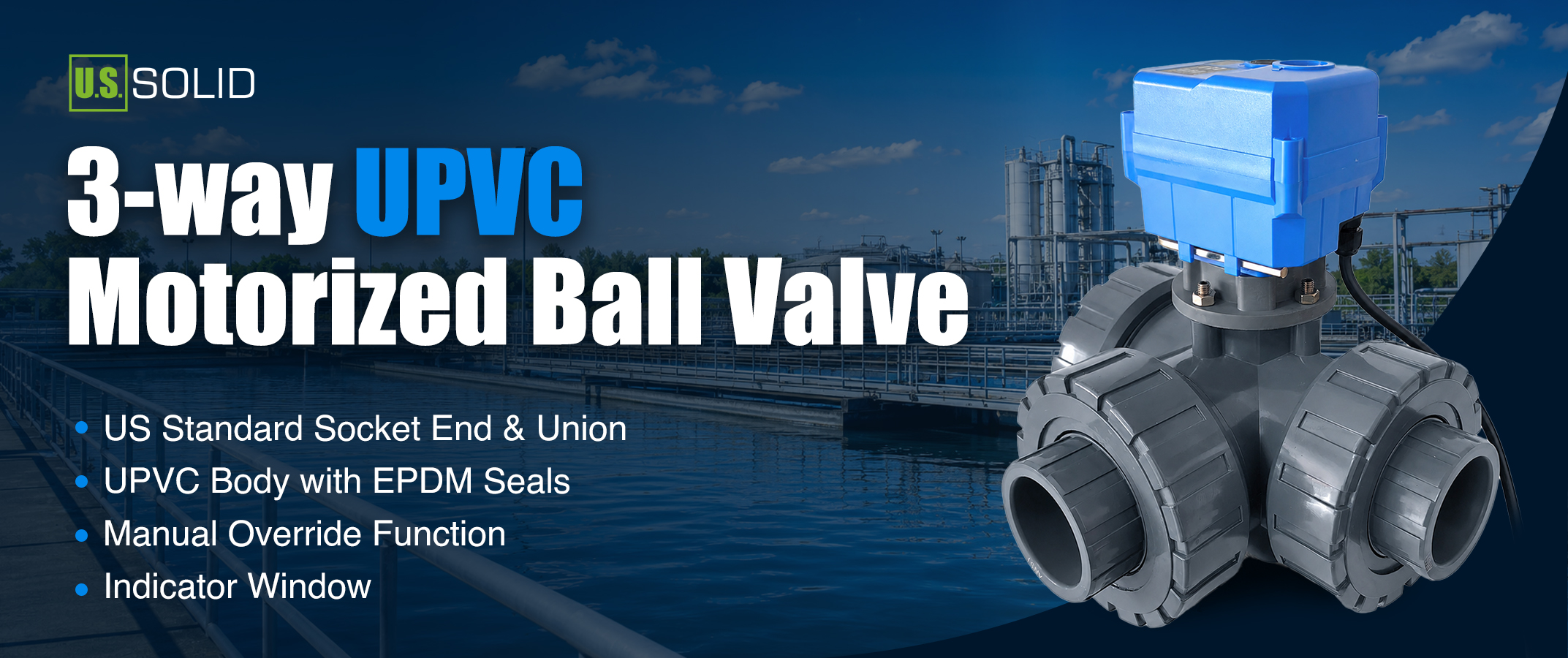
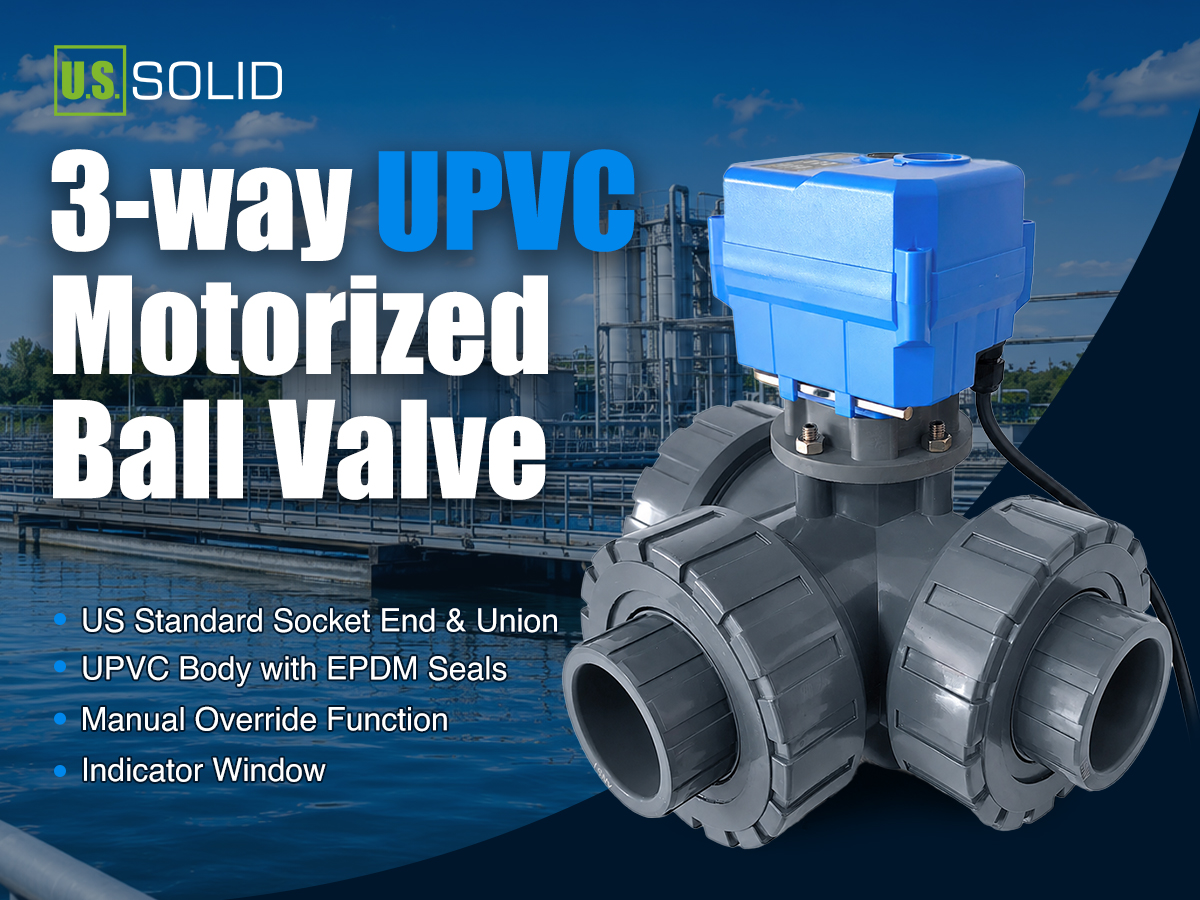
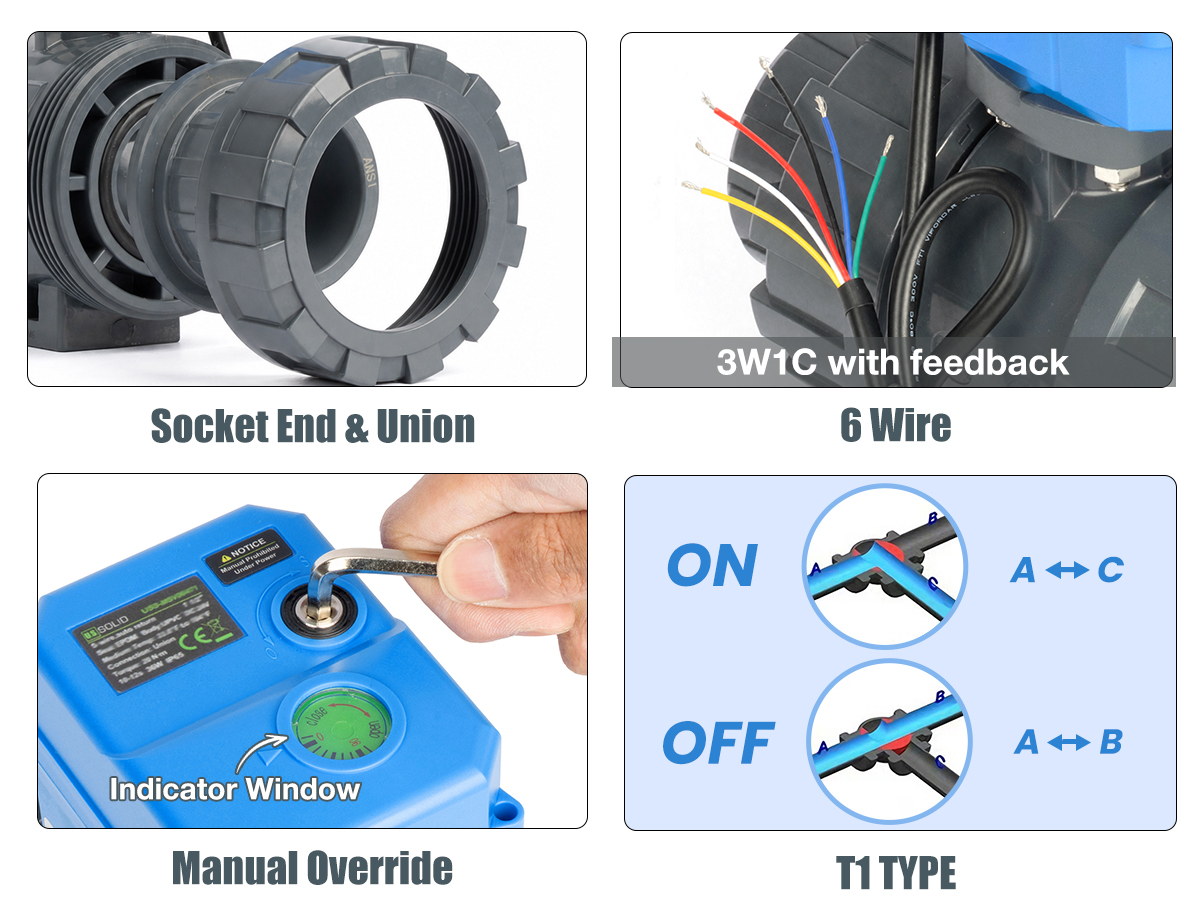
This UPVC 3-way motorized ball valve series provides an alternative solution to our standard brass/stainless steel threaded ball valves currently available. Distinguished from NPT/G threaded connections, this series adopts a US standard socket end & union connection, balancing stable sealing performance with the convenience of quick disassembly and maintenance. For other connection standards, please contact our customer service.
This model uses a 6-wire configuration integrating 3-wire single-control and 3-wire signal feedback functions. Unlike auto-return models, this version does not automatically return to a default flow path if power is lost; instead, it remains in its current ON or OFF flow path. The control setup includes a common wire, a constant power wire, and a single control wire to switch the valve between ON and OFF flow paths, while the feedback wires provide ON/OFF position feedback to a control or monitoring system. A manual override is also included for use during power outages. All models in this series have EPDM seals for reliable performance.
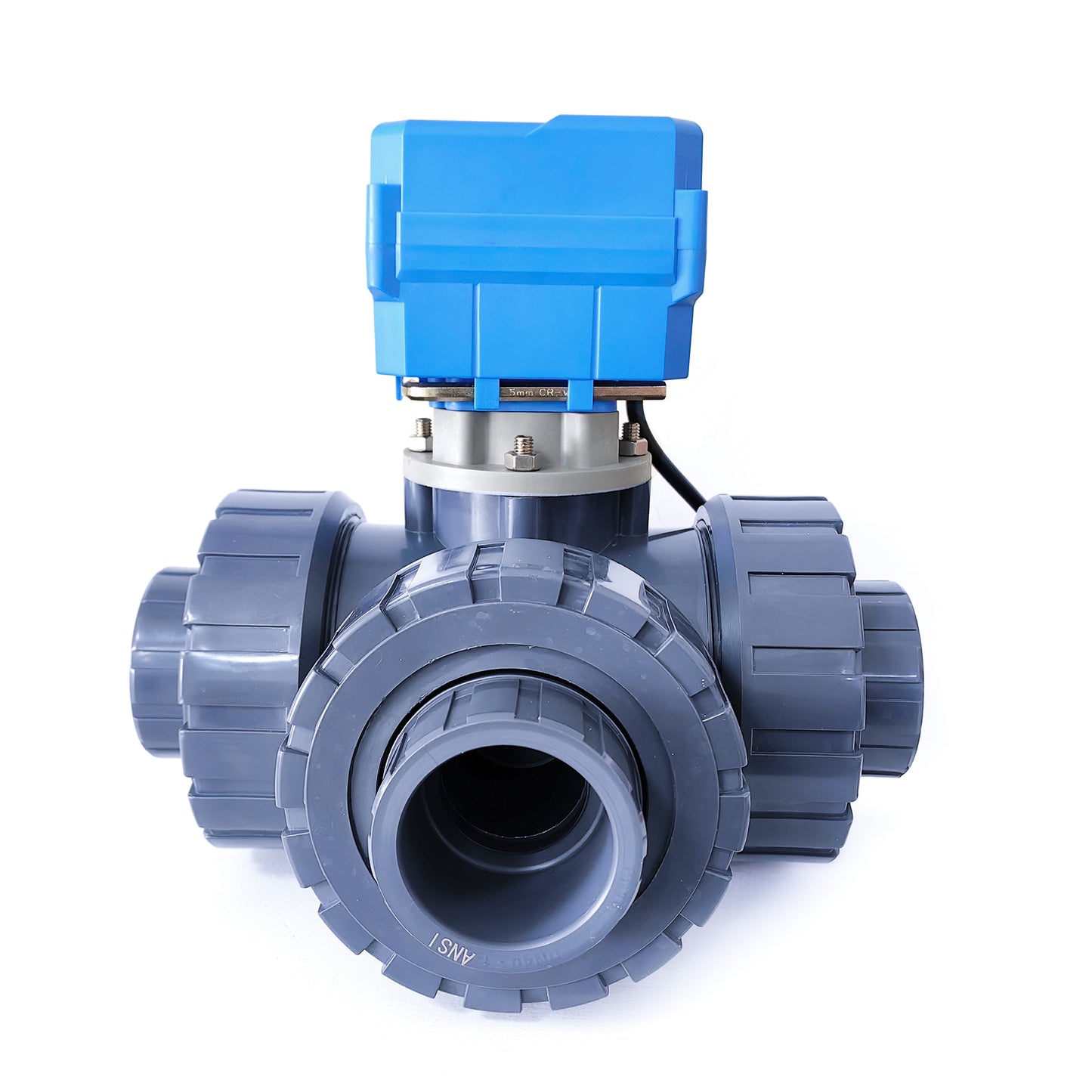
This 3-way valve series offers L-type and T-type configurations (2 options for T-type: T1/T2). Please note the distinction when purchasing and refer to the main images for flow path type details.
Applications
Features
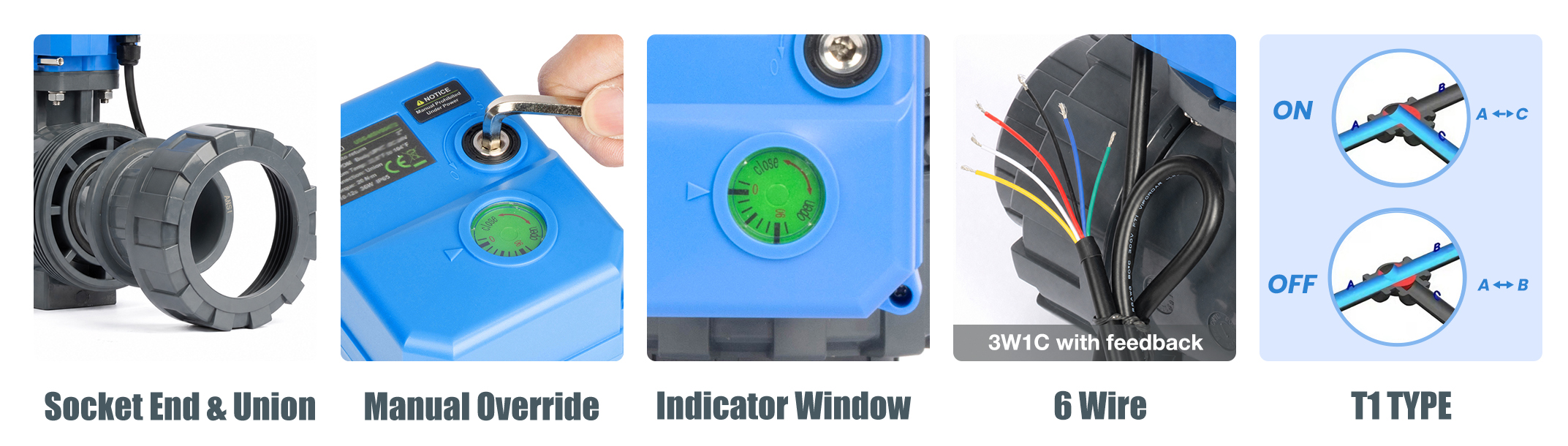
- Union & Socket End: Different from standard NPT/G threaded connections, it uses socket-gluing for sealing and integrates threaded structures, balancing connection stability with quick disassembly and maintenance needs.
- Manual Function: Comes with a hex wrench as standard; allows manual valve operation during power outages. "O" = ON, "S" = OFF.
- Indicator Window: Built-in engraved marks directly show the valve's ON/OFF status. External arrow pointing to "0" means OFF; pointing to "90" means ON.
- Premium Material: Valve body made of UPVC with EPDM seals, meeting general operating requirements.
- 6-Wire Single-Control with Signal Feedback: Uses a 6-wire configuration integrating 3-wire single-control and 3-wire signal feedback functions. The control setup includes a common wire, a constant power wire, and a single control wire to switch the valve between ON and OFF flow paths, while the feedback wires provide ON/OFF position feedback; the valve remains in its current flow path if power is lost.
User Manual
To learn how to use this product, please refer to the user manual.
Technical Data
| Port Size | 1-1/4" | Model | USS-MSV654 |
| Port | 3 Way, T1 Type | Thread | No Thread |
| Connection | Union & Socket End | Max Power | 15W |
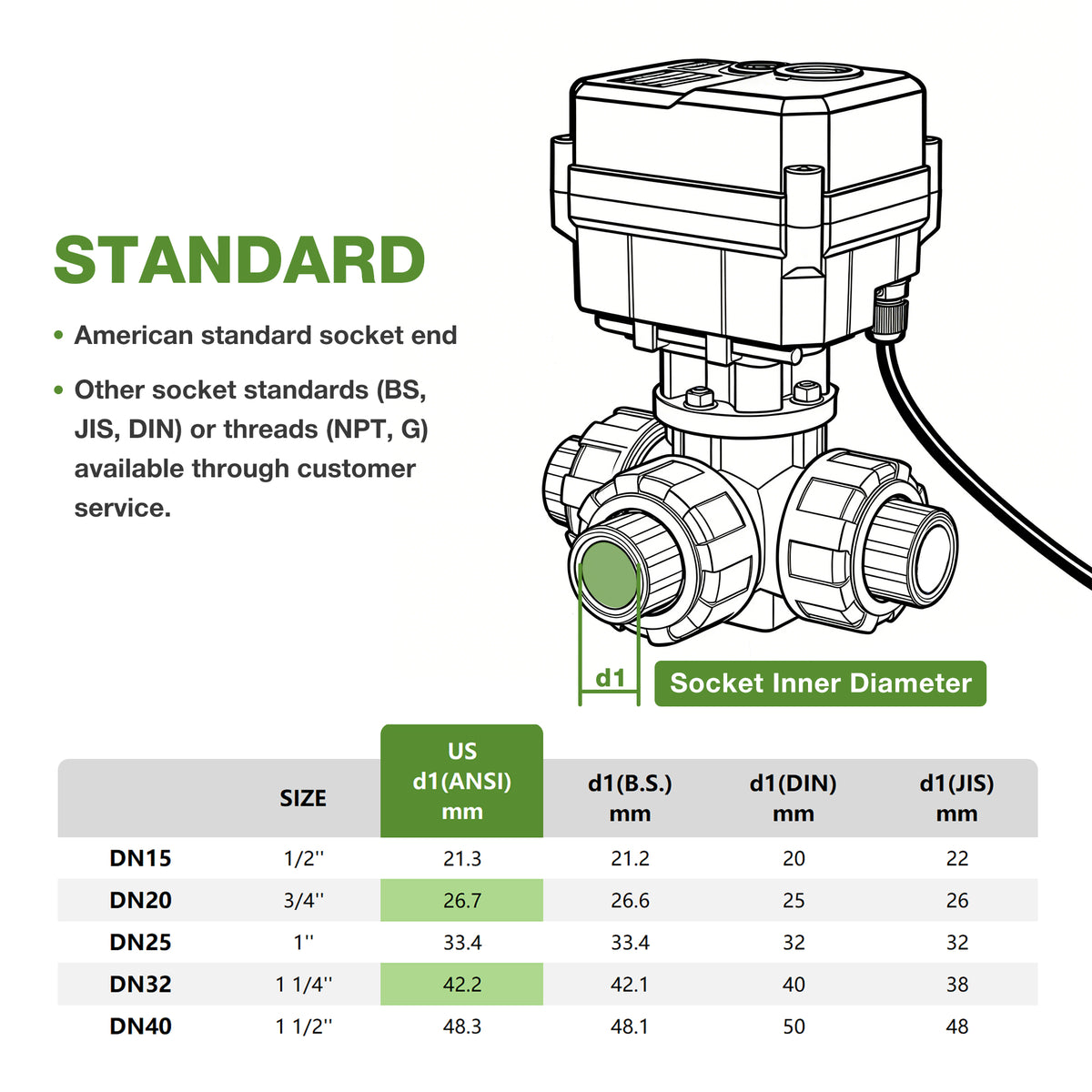
| Socket Inside Diameter | 42.2mm (US Standard) | With Hex Wrench | Yes |
| Wiring | 6-Wire (3-Wire Single-Control + Signal Feedback) | Manual Function | Yes |
| Signal feedback function | Yes | Indicator Window | Yes |
| Body Material | UPVC | Normal Position | No NO/NC distinction |
| Seal Material | EPDM | Temp Range (Medium) | 33.8℉ to 104℉ |
| Working Voltage | DC 24V | Close/Open Time | 10-12s |
| Max Torque | 20 N·m | Max. Pressure | 232 psi |
| Life Expectancy | 20,000 Cycles | IP Rating | IP65 |
| Package Size | 9.8"×7.9"×9.8" | Gross Weight | 6.8 lb |
*To view the full table on mobile, please swipe left or right on the screen.
6-Wire (3-Wire Single-Control + Signal Feedback)
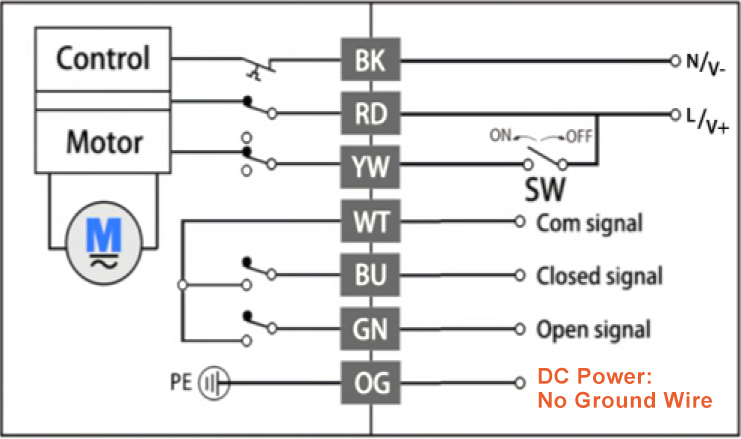
This model uses a 6-wire wiring method that combines 3-wire single-control operation with 3-wire signal feedback. For 3-way valves, the ON and OFF positions correspond to different flow paths. The valve switches between ON and OFF flow paths through a single control wire and remains in its current flow path if power is lost.
- The control setup includes a common wire, a constant power wire, and a single control wire.
- The feedback wires provide ON/OFF position feedback to a control or monitoring system.
- Wire Color Coding: BK (Black), RD (Red), YW (Yellow), WT (White), BU (Blue), GN (Green), and OG (Orange).
- Before manual operation, always disconnect power first.
FAQ
Problem 1: What is unique about the connection method of this ball valve?
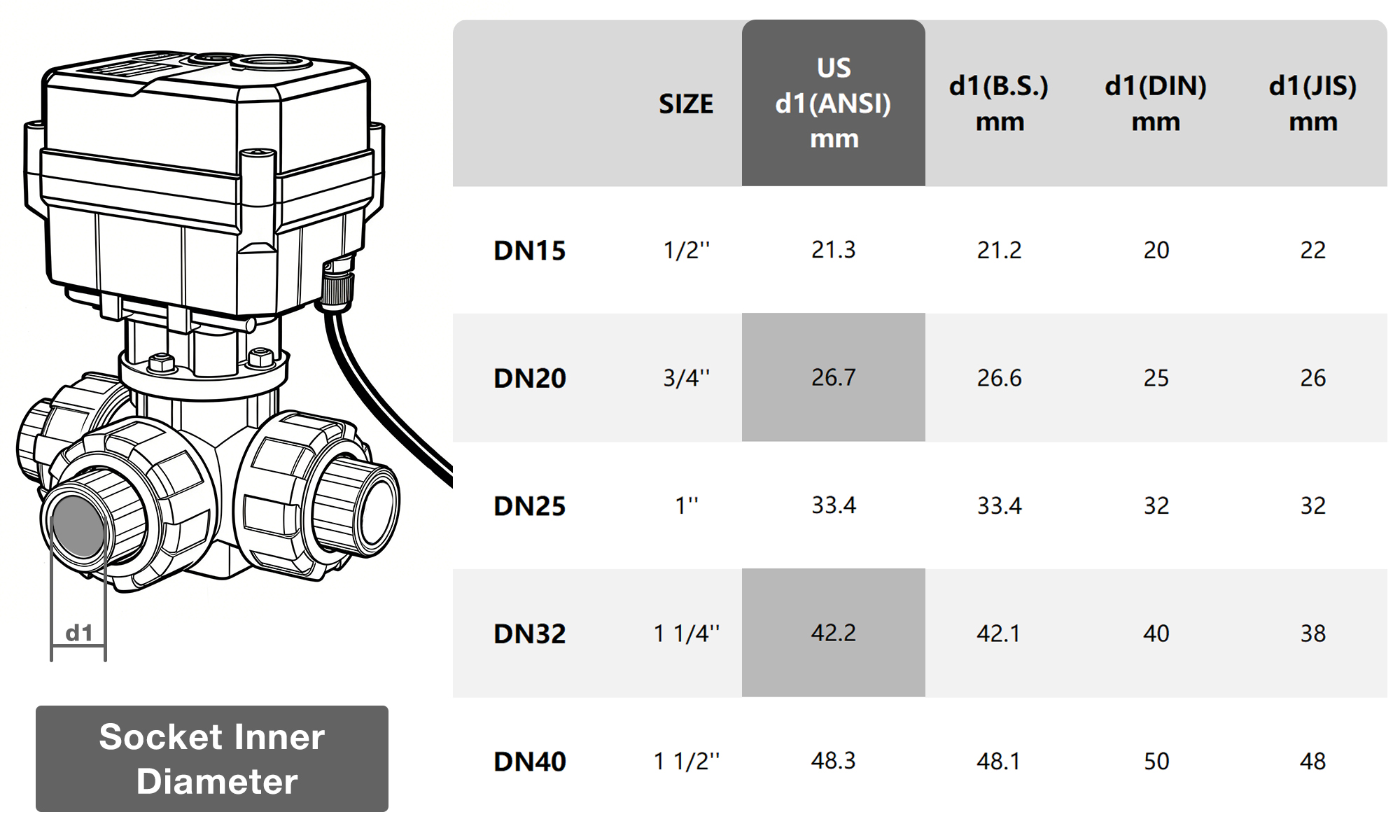
The larger sizes of our ball valve series (1-1/4", 1-1/2", and 2") come standard with Socket End ports for solvent cement bonding and a Union structure for easier installation and maintenance, instead of common threaded connections such as NPT or G.
This union design allows the valve body to be installed or removed more easily for maintenance or replacement, without cutting the pipe or rotating the valve body itself.
The pipe sockets are made to a US standard. Please note that the Socket Inside Diameter (I.D.) may vary by national standard even for the same nominal size, such as 1-1/4". For other connection standards, including British Standard, Japanese Industrial Standard, or others, please contact our customer service team.
Problem 2: Does a 3-way valve have normally open or normally closed status?
For 3-way valves, ON and OFF should be understood as two different flow path positions, rather than simply normally open or normally closed. Each ON/OFF position corresponds to a specific flow path. For auto-return models, the valve returns to its default OFF flow path when power is lost.
Problem 3: How to choose the correct 3-way flow path type?
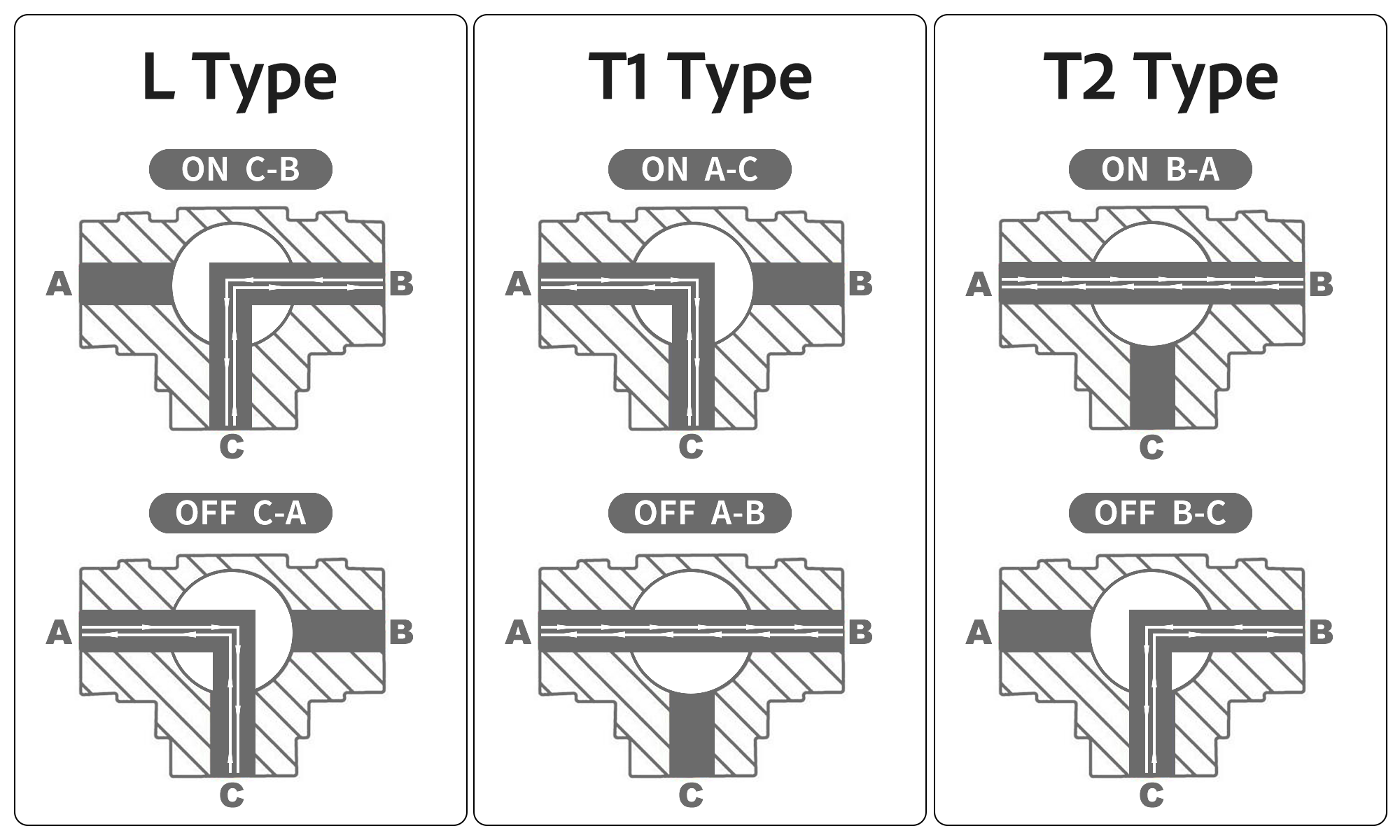
This 3-way electric ball valve is available in three flow path configurations: L-type, T-type T1, and T-type T2. The diagrams show the corresponding flow path for each configuration when the valve is in the ON and OFF positions.
Please note that ON and OFF each correspond to a different flow path. For wiring instructions specific to your model, please refer to the Wiring Schematics section. A connection such as C-B means the two ports are open to each other, not a fixed flow direction.
Problem 4: What precautions apply to auto-return models?
The auto-return ball valve requires a minimum power-on duration of 60 seconds (≥60s). This step is mandatory during first commissioning or after a prolonged power cut to ensure reliable auto-reset performance. Before using the manual override, always disconnect the power first. For auto-return models, please wait for a short period after power is disconnected before manual operation, as the actuator needs time to discharge; otherwise, the valve may be difficult to turn manually.
Problem 5: Does this model come with a manual function?
Yes. The manual override function allows you to control the valve position during a power outage. A hexagonal wrench is included with the valve for this purpose.
Power must be disconnected before manual operation. Turn the valve according to the "O" and "S" indicators: "O" = ON, "S" = OFF. The valve should be turned fully to the ON or OFF position; do not leave it in a middle position, as this may damage the valve. For auto-return models, wait for a short period after disconnecting power before manual operation.
Problem 6: How to read the indicator window?
The external arrow shows the valve position. When the arrow points to "0", the valve is in the OFF position; when it points to "90", the valve is in the ON position.
Problem 7: What is a Union connection?
A Union connection is a detachable valve structure that allows the valve body to be removed more easily for maintenance or replacement without cutting the pipe. On this product, the pipe connection ends are Socket End ports designed for solvent cement bonding.
Problem 8: What should be noted about the four main control methods?
Please pay attention to the wiring type when purchasing. Only auto-return models will automatically return to the default OFF flow path when power is lost. Other control methods do not automatically reset after power loss and will remain in their current flow path.